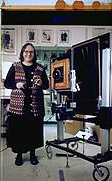
Elsa Dorfman (born April 26, 1937) is an American portrait photographer working in Cambridge, Massachusetts. She is known for using a large-format Polaroid camera. It's a fine and well-timed portrait of her life and work. Since she has extensive experience, it is also a historical depiction of photography from the time she started with black and white photography to the present day. Among other things, she used Polaroid's 20 x 24 big screen formats. There were only five copies of the camera and she had access to one that she rented for her portraits.
Elsa Dorfman / CC BY-SA (http://creativecommons.org/licenses/by-sa/3.0/)
Some of the famous people Elsa photographed are: Allen Ginsberg, Andrew Wylie, Victor Bockris, Anais Nin, W. H. Auden, Andrea Dworkin, Ed Sanders, Gail Mazur, Audre Lorde and Anne Sexton.
If you have Netflix, it's there. Link to Netflix.Th e movie is 1 hour and 16 minutes long.
"Kalotype", or "talbotype" was a developing process, developed from Henry Fox Talbot's previous image-developing process by using a different silver salt (silver iodide instead of silver chloride) and a developing agent (bile acid and silver nitrate) to produce an invisibly light "latent" image on the exposed paper. This reduced the exposure time in the camera to just a minute or two for subjects in bright sunlight.
The transparent negative kalotype made it possible to produce as many positive pressures as desired by simple contact pressure, while the daguerreotype was an opaque direct positive that could only be repeated by being copied with a camera. On the other hand, although the negatives were waxed to make the picture clearer, the kalo type was not as razor sharp as the metallic daguerreo type because the paper fibres blurred the printed image. The simple salt paper process was normally used when making prints from kalotype negatives. Talbot announced his kalotype process in 1841. In August, the first photographer was licensed to use the method.
In 1852, Talbot discovered that gelatin treated with potassium dichromate, a sensitizer introduced by Mungo Ponton in 1839, becomes less soluble when exposed to light. This later formed the basis of the important carbon pressure process and similar technologies. Dicromerad gelatinis tint is still used for some laser holography.
A method of development invented by William Fox Talbot in the 1830s, the foundation was plain table salt. The images are reddish brown to brownish violet tones with a matte finish. Salt paper copies are sometimes called kalotypier, kalotypi is actually a later development of William H. Fox Talbot's developing process.
The method was that a paper was prepared with saline made from ordinary table salt. Then brushed one side with silver nitrate solution, it creates a hardy surface of silver chloride that is photosensitive. The paper darkens when exposed to light and when the image appears clearly enough, the process is stopped with a strong saline solution. Gradually, sodium thiosulphate was used which was better at keeping the colors stable.
It is difficult to elicit on the saline paper , the chemicals are sensitive and unstable so it is easy to fail.
Silver nitrate toxic so it is necessary to be careful, it reacts easily with dirt, dust or rust from the water pipes and then the pictures become spotted and spotted, therefore distilled water is needed for the solutions. Iron destroys the process. It is also important that the water maintains the right temperature so as not to affect the process.
I realize that one has to read on about the whole process before one tries this. Modern paper contains a lot of chemicals that in turn affect the chemicals in the development.
Today I continued looking through my pictures on the computer. It's actually really hard to find new images that I'm happy with. I'd rather have tiveds theme or at least nature-themed but most of the pictures I took in Tiveden last year were so bad. First, I didn't succeed with the light, secondly, the previous lens doesn't fit very well on the camera so all images that aren't zoomed in have blurry vignetting. Therefore, I have also looked a bit at pictures I took with the Raspberry Pi camera but the camera is really difficult to set the focus on so even if the composition is perfect, the sharpness is in the wrong place.
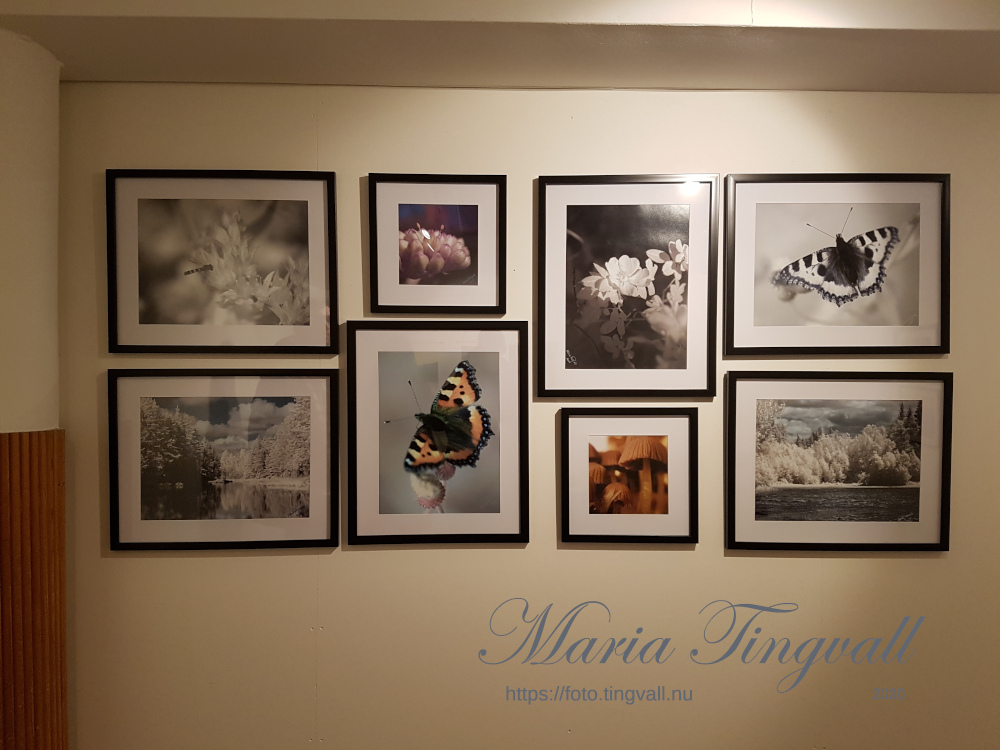
I'm going to go down and put up the pictures on Friday when it's first May and day off, then I'm going to take the opportunity to take some new pictures. Now it looks as if it may be overcast almost all of next week so it may not go so well. It depends on what I find to photograph, sometimes it can actually get better without the sun.
Me and my parents talked earlier this spring that I would exhibit my pictures in Bakstugan in Tiveden this summer. At first I felt like it was so far away in time and plenty of time to plan, then I got sick in covid-19 (pretty sure it was anyway) and then time has just passed. This week it occurred to me that Bakstugan usually open this time of year, but would they open as usual given the covid-19? It hasn't been talked about for a while, we've mostly talked about everyday things and how the pandemic affects us.
Bakstugan opens its doors for the season until next weekend and starts by having open weekends to begin with until the high season starts. I'm going to exhibit there! So now it will be to look through my old prints from Hasselfors and possibly find something new as well. It's going to be so much fun!
Dad has fixed adhesive strips to the floor so that visitors can keep their distance from each other and if it is nice weather there is plenty of room outside where you can sit and have coffee in the sun.
The tips I got from mom when I talked to her – and which I think is good to think about before most shows are:
It can fit about 10 pcs 60 cm wide paintings
The paintings are hung by wire from the ceiling
Number each board
Give each board a name
Make a list of the pictures and write what they cost
In my quest to learn more about different photography techniques through the ages, I ended up among something that was popular in the decades around 1900 and called Carte de Visite (business card in French), in Swedish: business card portraits. These were small portrait photographs patented by photographer André Adolphe Disdéri (1819–1889) in Paris in 1854. Before that, methods that only resulted in one image were used, unless the development failed, there were admittedly more expensive methods where it was possible to create multiple copies and images in larger format, but now it was possible to make eight copies at once. The disadvantage of the method was that it took some time to develop the images so the customer had to come back and pick them up.
The camera Disdéri used had four lenses. The card was usually produced according to the egg white method (albumin paper) which was the dominant method of producing photographic copies until the 1890s. On a glass negative in the format 18×24 cm, eight images were released each of 6×9 cm. A thin photograph was mounted on a thicker cardboard. The dimensions of the photograph were 54×89 mm and were mounted on a cardboard card that was 64×100 mm.
Carte de visite became popular in May 1859 when (according to an unsubstantiated but often repeated anecdote) the photographer Disdéri had the good fortune to be in the right place at the right time when Napoleon III interrupted his march to pose for a photograph in Disdéris studio. The photographs were made in size as a business card and were exchanged between friends and visitors. Pictures of celebrities were sold by photographers and paper dealers and turned into collectibles that filled the private photo albums. Since the photographs could be produced in large numbers, they became relatively cheap to buy. In the UK, for example, 300-400 images a year were sold in the 1860s. Fashion came to Sweden around 1860. In Europe, pictures of royalty were popular but also pictures from remote places such as the British colonies. The first photo albums that were produced were made so that people could collect their photos in them.
In the United States, Carte de Visite became popular during the Civil War when soldiers, relatives and friends were able to send pictures to each other, it was also inside to collect pictures of celebrities such as Abraham Lincoln. Pictures were printed to call for missing soldiers, they were used to explain the war and slavery, when the war ended, it could happen that bider was used to call for criminals as well. A company in Washington, USA, produced 3600 carte de visite every day during that period.
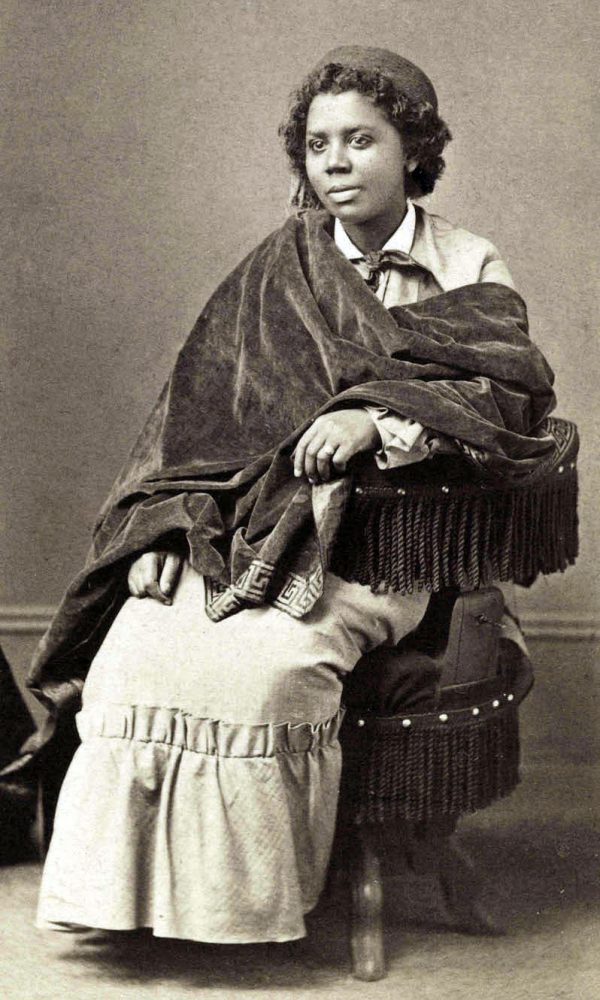
Edmonia Lewis was a well-known African-American sculptor working in Italy in the 1870s but moved back to the United States after some time. There she became one of the first to market herself with carte de visite.
Cabinet cards were slightly larger images that came in the early 1870s. They were also usually produced by album impressions but larger, mounted on cardboard discs of size 110x170mm. These were popular until the early 20th century when Kodak introduced the Brownie camera and amateur photography became a mass movement.
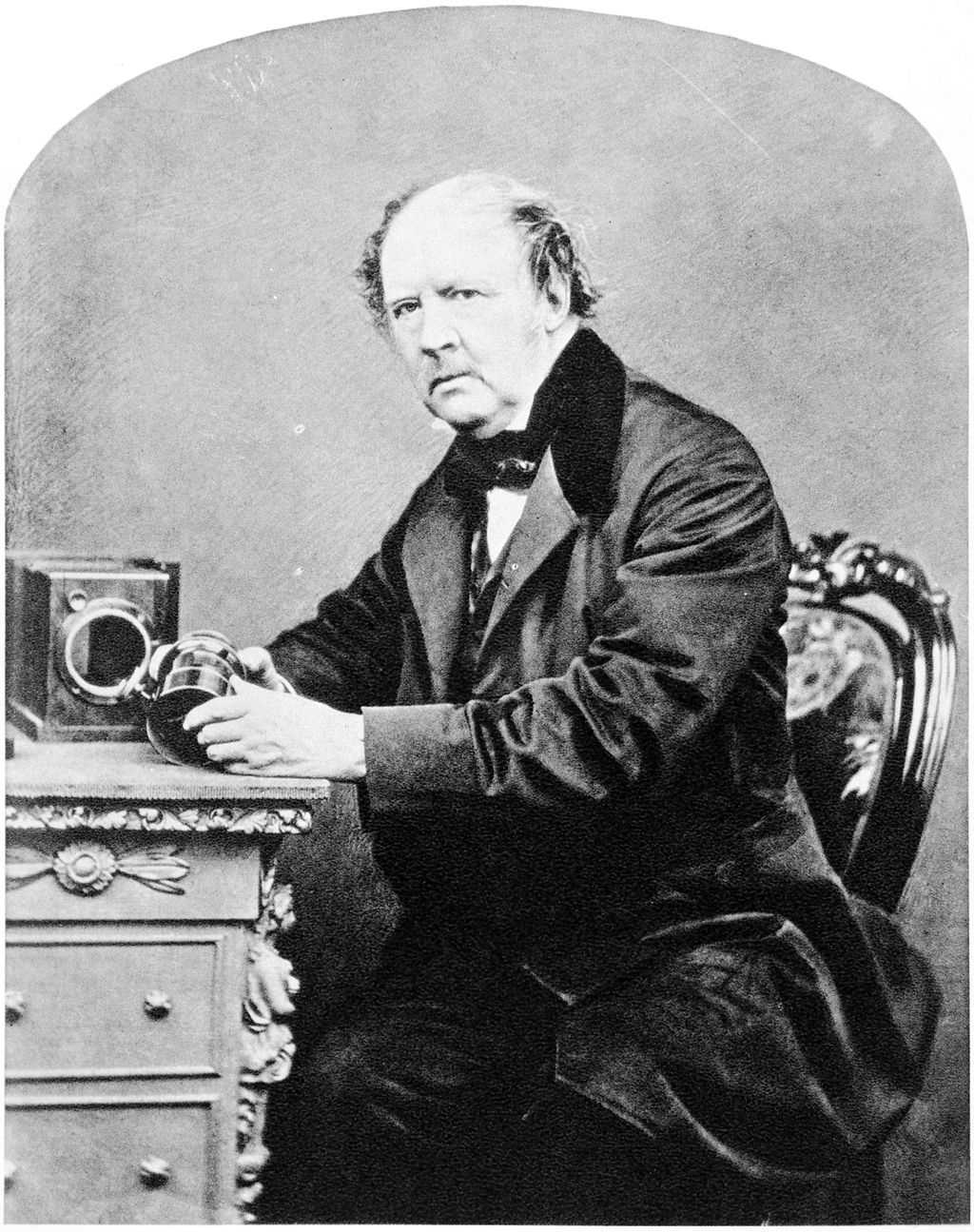
William Henry Fox Talbot (1800–1877) is a key figure in the history of photography: was one of the first inventors of various photographic processes and established the basic principle of photography as a negative/positive process.
Talbot was elected to the Royal Society in 1831 for his work on integral calculations and researched in optics, chemistry, electricity and other subjects such as etymology and ancient history.
In 1832 he married Constance Mundy and the same year he was elected mp for Chippenham. In 1833, when he visited Lake Como in Italy, he made unsuccessful attempts to sketch the landscape. The fact that it was so difficult for him made him dream of a new machine with light-sensitive paper that would automatically make the sketches for him. When he returned to England, he began working on this project at his home in Lacock Abbey, Wiltshire.
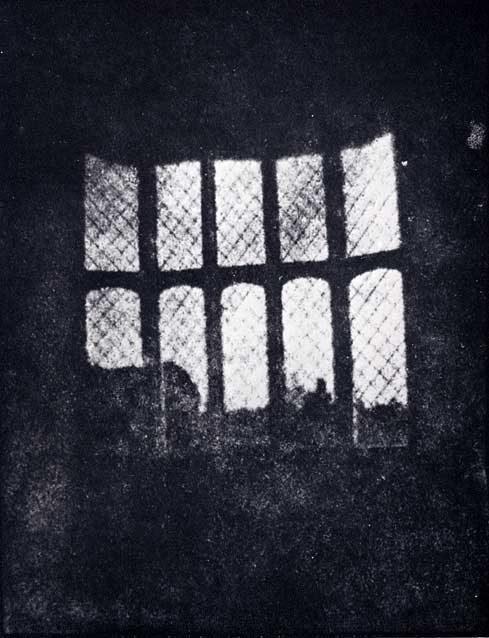
In 1834, five years before the public announcement of the daguerreotype, Talbot developed a process that gave a negative picture of sensitized paper. The negative could then be used to create several positive photographs through contact development. The Latticed Window in Lacock Abbey, one of Talbot's photographs, taken in August 1835, is the oldest known negative still to be found. Talbot was a man with many interests so he improved his method a bit over time, took some pictures when it suited him.
In early 1839, he discovered that Louis Daguerres had applied for a patent for his invention, the daguerreotype. The application was announced in early January 1839 and Talbot got into a patent dispute. Daguerre did not specify any details about what his method meant, therefore Talbot claimed that he was the first to develop images since he had begun experiments in early 1834. At a meeting at the Royal Institution in London on 25 January 1839, Talbot presented several paper photographs he had made in 1835. Within two weeks, he was able to describe his process in terms of the Royal Society, followed by more complete details a few weeks later. Daguerre did not reveal any useful details until mid-August, although it was already clear in the spring that his process and talbots were very different.
In September 1840, Talbot made another important breakthrough when he discovered that invisible or "latent" images were formed on sensitized paper even after relatively short exposure times. These images can be made visible or "induced" if treated with chemicals. By inventing the processes needed to make latent images visible and "fix" them so that they do not fade, Talbot contributed to the development of photography later being developed.
Talbot's later work focused on photomechanical reproduction methods. Mass production became easier and much cheaper, transferring a photograph to ink on paper made the images last much longer, ink was known to be permanent for hundreds if not thousands of years. Previous methods had problems with bleaching which had quite quickly become apparent for early types of silver paper. Talbot created the photoglycfa (or "photoglycptic") engraving process later enhanced by others like photoengraving.
Jeannette Klute (1918 – 2009) was an American photographer, she worked with development at the Eastman Kodak Company and was a pioneer in the artistic possibilities of color photography. Klute also paved the way for women to work in the photography industry.
Jeannette Klute was born in Rochester, New York in 1918. At the time, there were not so many career choices for women, they were largely referred to working as teachers or in health care. She graduated from high school in 1936, then applied to the Institute of Mechanics (now known as the Rochester Institute of Technology) in Rochester where she studied at the Department of Photography Technology. Klute was one of three women in the training with the goal of getting a job at the local company Eastman Kodak Company (Kodak). After her studies she worked for a while but after a while she took more courses on advanced photography and color processes in 1944. She also earned a bachelor's degree from the University of Rochester.
Klute began working at Kodak in October 1938 as a lab assistant, one of the few positions women had to apply for at the time. There she worked on improving the development technique. In 1945 she became head of the colour printing group and in 1949 she became a research photographer and led the research studio at the Division of Color Technology. It developed the processes and materials used in color photography. For much of his career, Klute worked as a photo illustrator for physicist Ralph M. Evans and illustrated many of his lectures, articles and books.
From the late 1960s and 1970s, Klute was head of photographic technology studio at Kodak. She made sure to hire women for most of the studio's research photography and engineering services which was very unusual at the time, the driving force being that she thought it was important to show women's skills.
Klute often brought his large-format camera into the forest and used a short depth of field to document the local flora and fauna. She helped develop a more abstract style. Her new and innovative techniques led to colour photography becoming more common as an art form. Klute's colour photography was exhibited in galleries and museums around the world. In 1975, Klute became one of fifty women selected for the groundbreaking exhibition Women in Photography: A Historical Survey, in which she was called "an innovator in color photography."
In 1954, Jeannette Klute published a book with her work entitled "Woodland Portraits". It is regarded as an important work in the history of color photography. She sorted the images by season and added poems to bring out the emotions of the viewer. Her work received good reviews and was groundbreaking in the field of photography.
After retiring, she began painting but continued to use nature as inspiration and created semi-abstract works to explore color and form. She died in 2009.
It is unclear when the history of photography began, it depends partly on what one means by it, and partly it is a bit in the nature of things that documentation and image evidence are destroyed over time. Two basic principles can in any case be derived from antiquity: camera obscura image projection and the discovery that certain substances are visibly altered by exposure to light. There is no physical evidence or descriptions to prove that anyone tried to capture images with light-sensitive material before the 18th century (possibly the photographic process used to create the mysterious Turin shroud from 1357 can be counted there).
Right from the start when photography began to develop, the goal was to be able to make color images. The 19th century can be summed up with development and experimentation around developing methods, while camera development took off in the 20th century.
Early history
300s f.kr described a camera obscura in the Chinese script Mozi
The 11th century The Arab physicist Ibn al-Haytham (Alhazen) writes very influential books on optics, including experiments with light through a small opening in a dark room.
13th century Albertus Magnus (1193 / 1206–80) discovered silver nitrate and found that it could blacken the skin. Silver nitrate is a photosensitive ingredient in photographic solutions for glass plates and film.
1357 Turin sweep, uncertain origin created sometime 1260-1390 according to carbon dating
Before the 16th century, camera obscura was used primarily to capture solar eclipses for scientific purposes
In the 16th century, it was known that a aperture stop would improve the lens's image quality.
16th century Georg Fabricius (1516–71) discovers silver chloride, which is later used to make photographic paper.
1550 Gerolamo Cardano describes a biconvex lens that can be used for the camera
1558 Giambattista della Porta proposes that camera obscura be used as an illustration tool
1568 Daniel Barbaro describes an aperture that gave brighter and sharper images
In 1614, Angelo Sala writes in his thesis "Septem Planetarum terrestrium Spagirica recensio": "When you expose powdered silver nitrate to sunlight, it becomes black as ink". He also noted that paper wrapped around silver nitrate for a year had turned black.
1685 is the first time anyone imagines a camera that is small enough and portable enough to be practical for photography. It is Johann Zahn who does it but it takes almost 150 years before it becomes a reality.
1694 Wilhelm Homberg describes how light causes certain chemicals to darken (photochemical effect)
18th century
Around 1717, Johann Heinrich Schulze caught cut-out letters on a bottle with a light-sensitive mourning, unfortunately he did not think that it could be possible to make the results sustainable.
In 1717 the German Johann Heinrich Schulze accidentally discovers that a slurry of chalk and nitric acid in which some silver particles were dissolved became darker by sunlight. Schulze called the subject "Scotophorus" when he published his findings in 1719. Schulze's process is similar to later photogram techniques and is sometimes regarded as the very first form of photography.
In the early science fiction novel Giphantie, the Frenchman Tiphaigne de la Roche describes something rather similar (color) photography, a process that fixes fleeting images formed by light rays
In 1777, the Swedish chemist Carl Wilhelm Scheele studied the light-sensitive silver chloride in detail and realized that it darkened in light by decomposing into microscopic dark particles of metallic silver. Scheele also found that ammonia dissolves silver chloride but not the dark particles. This discovery could have been used to stabilize or "fix" a camera image taken with silver chloride, but none of the first people experimenting with photography understood this. Scheele also noted that red light did not have much effect on silver chloride, a phenomenon that would later be applied in photographic darkrooms as a method of seeing black-and-white prints without destroying the development.
19th century
Around 1800, Thomas Wedgwood (1771-1805) made the first documented attempt to capture camera images in permanent form. His experiments created detailed photograms, but Wedgwood and his collaborator Humphry Davy were unable to find any way to fix these images despite being imspired by Scheele (1777).
In 1801, The Frenchman Jacques Charles is believed to have come up with the method of making fleeting silhouette photograms, he did not document the method but gave lectures and some claim he was ahead of Wedgwood.
In 1804 William Hyde Wollaston invented a positive meniscus lens for glasses.
In 1812, William Wollaston adjusts the eyewear lens so that it can be used for camera obscura by mounting it with the concave side facing outwards with an aperture stop in front of it making the lens reasonably sharp over a wide field. Daguerre used this lens in his experiments, but since it was a single-element lens that lacked all chromatic aberration control, it was impossible to focus exactly with the blue-sensitive medium in the daguerreotype process.
In 1816 the Frenchman Nicéphore Niépce succeeded with paper coated with silver chloride to photograph the images formed in a small camera, but the photographs became negative, darkest where the camera image was brightest and vice versa and they were not permanent.
1820s Nicéphore Niépce discovers a method of fixing images taken with a camera. The images were exposed from hours to days and became very blurry.
1826 or 1827 oldest preserved photograph, taken by Nicéphore Niépce
In 1828 Nicéphore Niépce begins to use Wollaston Meniscus.
The 1830s used the word photography (from greek photos = light and graphein = to write) for the first time
Around 1832, Charles Wheatstone develops the stereo shoe
1832 or 1833 Hércules Florence (1804-1879) developed its own photographic technique in Brazil with the help of the pharmacist Joaquim Corrêa de Mello (1816-1877). There were pictures of paper treated with silver nitrate as contact pressure or in a camera obscura. They may have been the first to use the word "photographie" (French)
1833 Niépce dies and Daguerre, who worked with him, takes over his work. Daguerre continues to experiment with chemicals such as iodine, silver iodine and mercury.
In 1833, Peter Barlow invented the so-called Barlow lens, a negative achromat magnifying glass that is still sold to increase eyepiece magnification of amateur telescopes. The teleconverter is the modern photographic equivalent.
1838 Charles Wheatstone presents his invention stereoskopet. He was helped by Henry Fox Talbot to make some kalotype pairs for the stereoshoe.
1839 Louis Daguerre, colleague of Nicéphore Niépce, seeks patents for daguerreotypi which became the leading developing method until the end of the 1850s
In 1839 John Herschel made the first glass negative, but his process was difficult to reproduce.
In 1839, François Arago tells a marvellous audience about the new invention that the photograph was and shows the first photo taken in Egypt; that of Ras El Tin Palace.
In 1839, Charles Chevalier created an achromatic version of the glass lens that combines field smoothing and control of chromatic deviation. It's pretty sharp within 50°. It adjusts the acrobatson so that the colors at the blue end of the spectrum match the blue-sensitive photographic emulsion. Due to its function, this lens became known as the "French landscape lens" or simply "landscape lens".
In 1840 in October Wheatstone had some pictures but was not completely satisfied because the angle between the images was too large. Between 1841 and 1842, Henry Collen made kalotypes of statues, buildings and portraits, including a portrait of Charles Babbage taken in August 1841. Wheatstone also received daguerreotype stereograms from Mr. Beard in 1841 and from Hippolyte Fizeau and Antoine Claudet in 1842. None of these have been found.
In 1840, Chevalier in France introduces the achromatic lens formed by attaching a biconvex lens glass with a plano-concave lens.
In 1840, the French Association for the Encouragement of National Industry announces an international competition because the achromatic landscape lens was so slow and a fast lens was needed.
In 1840, Joseph Petzval (in modern Slovakia) participates in the competition, which was called by a French Association for the Encouragement of National Industry. Petzval was a mathematics professor with no experience in optical physics, but with the help of several human computers from the Austro-Hungarian army, he took on the challenge of producing a lens quickly enough for a daguerreotype portrait. He developed petzval's portrait lens (modern Austria), a lens with four elements consisting of a front cemented chrome plate lens and a rear achromate lens with air space, the first portrait lens with wide opening. It was suitable for one- to two-minute shaded exposures of the daguerreotype outdoors. With the faster collodion process (wet plate) developed in the 1850s, a camera equipped with this lens could take one to two minutes of indoor portraits. Due to national chauvinism, Petzval did not win the prize, although he was much superior to all other participants
In 1841, Voigtländer manufactures the first commercially successful two-element lens based on Joseph Petzval's design and uses it in a camera. Voigtländer-Petzval is the first camera and lens specifically designed to take photographs instead of just being a modified artist-camera obscura.
In 1841 the Slovenian Janez Puhar invents a process of making photographs by glass, the method was recognized on 17 June 1852 in Paris by the Académie Nationale Agricole, Manufacturière et Commerciale.
1844 David Brewster develops a stereo bucket with lenses and a binocular camera
In 1845, Francis Ronalds of the Kew Observatory invented a forerunner of the film camera. A light-sensitive surface is slowly pulled past the camera's aperture membrane with a clock mechanism to allow continuous recording over a 12- or 24-hour period. Ronalds uses the cameras to track the ongoing variations in scientific instruments and they were used in observatories around the world for over a century.
In 1847, The Cousin of Nicephore Niépce, the chemist Niépce St. Victor, published his invention for the production of glass plates with album enemulsion
Mid-1840s, the Langenheim brothers from Philadelphia and John Whipple and William Breed Jones from Boston also invent feasible processes with negative glass
In 1848, Edmond Becquerel showed attempts to create color images, but they required exposure times of hours up to days and were very light-sensitive.
In 1851, Frederick Scott Archer invents the collodion process. Photographer and children's author Lewis Carroll used this process. (Carroll refers to the process as "Tablotype" in the story "A Photographer's Day Out".
In 1851, a pamphlet by the daguerreotypist Augustus Washington is published with prices ranging from 50 cents to 10 dollars. However, daguerreotypes were fragile and difficult to replicate. Photographers encouraged chemists to refine the process in order to make many copies cheaply, which eventually led them back to Talbot's process.
In 1855, Scottish physicist James Clerk Maxwell proposed to try three filters in red, green and blue to produce colour images.
In 1858, the first elective aperture times, the Waterhouse aperture, named after John Waterhouse. et is a set of accessories of brass plates with large holes, mounted through a gap on the side of the lens structure.
In 1858, the specific type of iris used in modern lenses is invented by Charles Harrison and Joseph Schnitzer. Harrison and Schnitzer's iris membranes were able to quickly open and close in cycles which is necessary for lenses with automatic aperture control.
1861 Thomas Sutton shows the first durable color photograph. He used three black-and-white photographs taken through red, green and blue color filters that he showed superimposed using three projectors with similar filters. The photographic emulsions used at the time were insensitive to most of the spectrum, so the result was poor and the method fell into oblivion.
In 1862 comes the first successful wide angle lens from the Harrison & Schnitzer Globe (USA) with f/16 as the maximum aperture (f/30 was more realistic). The lens had a maximum field of view of 92° (80° was more realistic). Charles Harrison and Joseph Schnitzer's Globe lens had a symmetrical shape with four elements; the name refers to the assumption that if the two outer surfaces continued and then merged, they would form a sphere.
In 1866, Dr Ernst Abbes is employed at Carl Zeiss' workshop, leading to several new products being developed in quick succession and for the Zeiss company to the cutting edge of optical technology.
In 1869 on the same day, two French inventors: Louis Ducos du Hauron and Charles Cros, unaware of each other's projects in the 1860s, present their almost identical works. They had come up with a set of three color filtered black and white photographs in color without projecting them and so that it was possible to make full-color printing on paper.
1873 Hermann Wilhelm Vogel discovers a way to make emulsions sensitive to the entire color spectrum, it was gradually introduced to commercial use for color development from the mid-1880s.
In 1876, Wordsworth Donisthorpe proposed a camera to take a series of pictures of glass tiles to be printed on a roll of paper.
Around 1880, photographers realize that the aperture size affects the field depth. Aperture control takes on greater importance and adjustable times become a standard lens function. The iris membrane came as an adjustable lens stop in the 1880s, and it became the standard adjustable stop around 1900.
1881 Herbert Bowyer Berkeley has experimented with his own version of collodion emulsions and publishes his discovery in which the formula contains pyrogallol, sulphite and citric acid. Ammonia is added just before use to make the formula alkaline. The new formula was sold by the Platinotype Company in London as Sulpho-Pyrogallol Developer.
In 1884, George Eastman in Rochester, New York, develops dry gel to use on paper or film to replace the photographic plate so that a photographer no longer has to carry around large boxes of plates and toxic chemicals.
In 1887, British inventor William Friese-Greene began experimenting with the use of paper film, made transparent by oiling, to record film. He also said he tried to use experimental celluloid, made with the help of Alexander Parkes.
1888 in July, Eastman's Kodak camera comes on the market with "You press the button, we do the rest" as the slogan. Now virtually anyone can take a photograph and leave the more complicated processes to others.
In 1888, new optical glass began to appear on the market after Ernst Abbe tried to eliminate astigmatism under a microscope and realized that the supply of optical glass was insufficient. He was hired by Otto Schott, who founded the famous glass works at Jena, where new types of optical glass are produced by Zeiss and others at the factory.
In 1888, a film camera was designed in England by Frenchman Louis Le Prince. He had built a 16-lens camera in 1887 in his workshop in Leeds. The first 8 lenses would be triggered in quick succession by an electromagnetic shutter on the sensitive film; the film would then be moved forward so that the other eight lenses could work on the film. After much testing and troubleshooting, he was finally able to develop a single lens camera that he used to photograph sequences of moving images on paper film, such as Roundhay Garden Scene and Leeds Bridge.
In 1889, Friese-Greene patented a moving photo camera that can take up to ten photos per second. Another model, built in 1890, uses rolls of the new Eastman celluloid film, which he perforated. A report on the patented camera is published in the British Photographic News in 1890. He shows his cameras and movies on many occasions but never in public. He sends details of his invention to Edison in February 1890 which was also seen by William Kennedy Laurie Dickson.
In 1889, Wordsworth Donisthorpe patented a film camera in which the film moves continuously.
In the 1890s, brothers Auguste and Louis Lumière began working on the first widely used method of color photography, the autochrome plate. It was based on one of Louis Duco's du Hauron's ideas: instead of taking three separate photographs through color filters, take one through a mosaic of small color filters that are premeditated on the emulsion and see the results through an identical mosaic. If the individual filter elements were small enough, the three primary colours of red, blue and green would merge in the eye and produce the same additive colour synthesis as the filtered projection of three separate photographs.
In 1890, Paul Rudolph designs an asymmetric lens with a cemented group on each side of the membrane and called it the "Anastigmat". This lens is manufactured in three series: Series III, IV and V, with maximum apertures of f/7.2, f/12.5 and f/18 respectively.
In 1891, Paul Rudolph designs the Anastigmat series I, II and IIIa with respective maximum openings of f/ 4.5, f/ 6.3 and f/9
In 1891, Thomas Dallmeyer and Adolf Miethe simultaneously try to patent new lens designs with almost identical formulas – complete telephoto lenses consisting of an anterior achromat duplicate and posterior achromat triplet. It was never established who was really first and no patent was ever granted for the first telelens.
1891 design William Kennedy Laurie Dickson, a Scottish inventor and employee of Thomas Edison, the Kinetografkamera. The camera was powered by an electric motor and was able to take pictures with the new sprocketed film. It is the first practical system for the high-speed stop-and-go film movement, which became the basis for the next century of kinematography.
1893 designs Paul Rudolph Anastigmat Series IIa with f / 8 maximum opening. These lenses are now better known by the brand name "Protar" which was first used in 1900.
1893 comes the crucial photographic lens of the twentieth century: Taylor, Taylor & Hobson Cooke Triplet. It became a budget variance used for most of the 20th century.
In 1894, the Protarlinse Series VII, the most highly corrected lens, is marketed with a single combination with maximum apertures of between f/11 and f/12.5, depending on its focal length.
In 1894, the Lumière Domitor camera owned by brothers Auguste and Louis Lumière is created by Charles Moisson, chief mechanic at the Lumière workshop in Lyon. The camera uses paper film 35 millimeters wide
In 1894, Polish inventor Kazimierz Prószyński constructs a projector and camera in one, an invention he calls the Pleographer.
In 1895, the Lumière brothers changed from paper to celluloid film they bought from New York's Celluloid Manufacturing Co. This covers them with their own Etiquette-bleue emulsion, cuts it into strips and perforates.
In 1896, the Planar Series Ia comes with maximum aperture of up to f/3.5 which is one of the fastest lenses but although it is very sharp, it suffers from coma and does not become very popular. Paul Rudolph had investigated the Double-Gauss concept on a symmetrical design with thin positive membranes that enclosed enclosed negative elements. But the further development of this configuration made it the standard design for high-speed lenses with standard coverage.
20th century
1901 photography becomes a little more accessible to the big masses when the camera Kodak Brownie is introduced.
1902 sold the main Zeiss lens from Paul Rudolph, Tessar series IIb f / 6.3. It is composed much like a combination of the front half of Unar with the back half of the Protar. This is a valuable and flexible design with enormous development potential. Its maximum aperture was increased to f/4.7 in 1917 and reached f/2.7 in 1930. It is likely that each lens manufacturer has produced lenses in the Tessar configuration.
1905 comes the first telelens to optically correct and fix deviations as a system, f/ 8 Busch Bis-Telar (Germany).
In 1907 the brothers Auguste and Louis Lumière's invention autochrome plate is commercially introduced.
In 1909 the Polish inventor Kazimierz Prószyński built and patented the Aeroscope in England between 1909 and 1911. It is the first successful handheld film camera. The cameraman doesn't have to turn the crank to feed the film, like any other camera at the time, so he can handle the camera with both hands, hold the camera and check the focus. This makes it possible to film with the aeroscope in difficult circumstances such as from the air or for military purposes.
1911-1912 comes the first cine-camera made entirely of metal, The Bell & Howell Standard.
In 1913, the first cameras were sold aimed at the public, it was called Tourist Multiple and sold in relatively many copies.
In 1913 Oskar Barnack, head of research and development at Leitz, began trying to use 35 mm cine film for still cameras while trying to build a compact camera that could make high-quality magnifications.
In 1923 Leitz sampled Oscar Barnack's design in 1923 and 1924 and received enough positive feedback to start producing the camera as Leica I (short for Leitz-camera) in 1925. Leica meant that 35 mm became an informal standard for advanced compact cameras.
In 1923, Eastman Kodak introduced a range of 16mm film developed from the Bell & Howell Standard from 1911-12, mainly as a cheaper alternative to 35mm and several camera manufacturers are launching models to take advantage of the new market for amateur filmmakers. At first it was considered to have inferior quality compared to 35 mm but 16 mm cameras continued to be manufactured until the 2000s by Bolex, Arri and Aaton.
1925 Leica I goes on sale.
1928 the first practical reflex camera, Franke & Heidecke Rolleiflex medium format TLR
1932 Contax is introduced to the photo market.
1932 comes one of the most complicated cine-camera models, the Mitchell-Technicolor Beam Splitting Three-Strip Camera. It obtains three color separation originals behind a purple, a green and a red light filter, the latter being part of one of the three different raw materials used.
In 1933, Seiki-Kōgaku Kenkyusho – Precision Optical Instruments Laboratory – or The Precision Optical Instruments Laboratory – or The Precision Optical Instruments Laboratory – or the Most-In-Law Of Canon in Japan, they make a camera prototype they call Kwanon
In 1933, Ihagee Exact, a compact SLR that uses 127 reel film, was introduced.
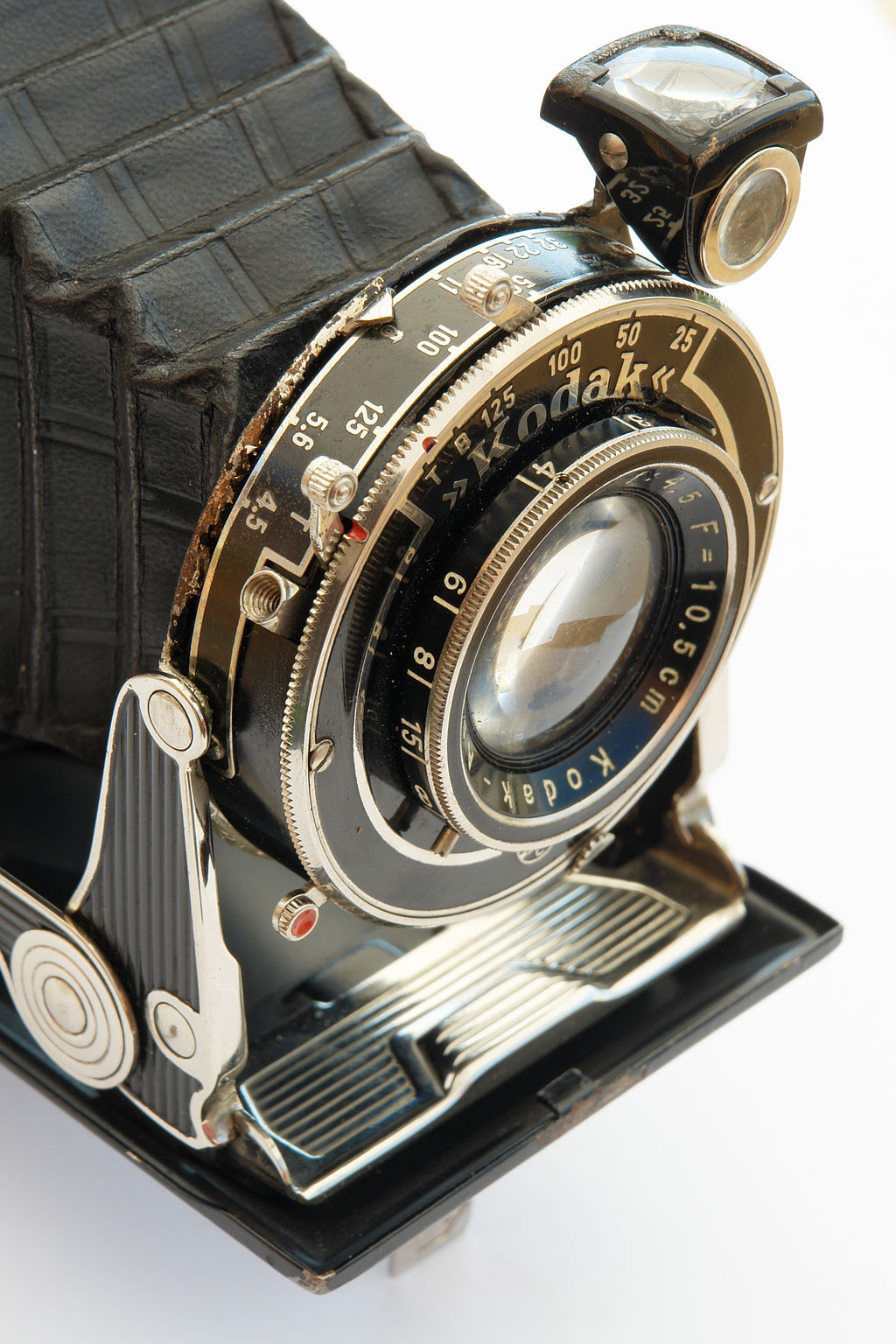
1934 presents kodak Retina I, it uses the 135 cassette that was used in all modern 35 mm cameras of the time. Although retina is relatively cheap, 35mm cameras are still too expensive for most people and roll film remains the most common format.
In 1935, Kodachrome film was introduced for 16 mm home movies. The film captures the red, green and blue color components of an emulsion consisting of three layers. A complex processing process creates complementary cyan, magenta, and yellow color images in each layer, resulting in a subtractive color image.
In 1935, Olexander Smakula invented the last important Zeiss innovation before World War II, the technique of applying anti-reflective coating to lens surfaces.
In 1936 Kodachrome film was introduced for 35 mm slides.
In 1936, Argus A is introduced, which uses the cheaper 35 mm film and therefore becomes less expensive for the consumer to buy
In 1936, the Canon 35 mm Rangefinder, an improved version of Kwanon, was presented.
In 1938, the first auto-exposure camera is the one with selenium light meters equipped and fully automatic Super Kodak Six-20 package, but its extremely high price of $225 (equivalent to $4,877 and roughly 50,000 SEK in 2019) prevents it from achieving any degree of success.
In 1939 the popular Argus C3 is introduced, which also uses 35 mm film.
In 1947, the Hungarian duflex is the first camera where the viewfinder was now placed at eye level, becoming the first major SLR innovation since World War II. Before, all SLR cameras were equipped with viewfinder screens held at waist level. Duflex was also the first SLR to have an instant return mirror which prevented the viewfinder from disappearing after each exposure.
The 1948 Contax S becomes the first camera to use a pentaprism. The same time period introduced Hasselblad 1600F which sets the standard for medium format SLR for decades.
In 1948, polaroid Model 95, the world's first practical camera with direct image, was introduced. Known as the Land camera by inventor Edwin Land, it uses a patented chemical process that creates ready-made positive pressures from the exposed negatives in under a minute. The country camera is becoming popular despite its relatively high price. The Polaroid range will be expanded to include dozens of models until the 1960s.
In 1949, the modern lens opening markings for f-numbers are standardized in geometric sequence by f/ 1,4, 2, 2,8, 4, 5,6, 8, 11, 16, 22, 32, 45, 64, 90, etc. Previously, this British system competed with the continental (German) sequence of f/1.1, 1.6, 2.2, 3.2, 4.5, 6.3, 9, 12.5, 18, 25, 36, 50, 71, 100 etc. In addition, there was uniform system (US, UK) sequence with 1, 2, 4, 8, 16, 32, 64, 128 etc. (where US 1 = f / 4, US 2 = f / 5.6, US 4 = f / 8, etc..) used by Eastman Kodak in the early 20th century.
From the 1950s onwards, Maxwell's method of taking three separate filtered black-and-white photographs continues to serve special purposes, and Polachrome, a "fast" image film that used Autochrom's additive principle, was available until 2003, but the few colour prints and slide films still made in 2015 use all the multilayer emulsion methods like Kodachrome, which were truly groundbreaking.
In the 1950s, several Japanese camera manufacturers entered the SLR market, such as Canon, Yashica and Nikon. Nikon's Nikon F camera had a whole range of interchangeable components and accessories and is generally regarded as the first Japanese SLR and contributes to Nikon's reputation as a manufacturer of professional-grade equipment.
1952 Japanese cameras are becoming popular in the West after war veterans and soldiers stationed in Japan bring cameras home.
In 1952, Asahi Optical Company (later known for its Pentax cameras) introduces the first Japanese SLR with 135 film, Asahiflex.
In 1957, a team led by Russell A. Kirsch of the National Institute of Standards and Technology developed a binary digital version of an existing technology, wirepoto drum scanner, so that alphanumeric characters, diagrams, photographs and other graphics can be transferred to digital computer memory. One of the first scanned photographs was an image of Kirsch's son Walden with a resolution of 176×176 pixels and only one piece per pixel, i.e. black and white without intermediate grays, but by combining multiple scans of the photograph made with different black and white threshold settings, information about grayscale could also be obtained.
1959 Mohamed M. Atalla and Dawon Kahng at Bell Labs invent MOSFET (MOS field effect transistor) which forms the basis of metal oxide semiconductor technology (MOS) found in image sensors in digital cameras. This led to the development of digital image sensors with semiconductors such as the charging device (CCD) and later the CMOS sensor.
In the 1960s, cheap electronic components are becoming common place and cameras equipped with light meters and automatic exposure systems are becoming more common.
In the 1960s, Eugene F. Lally of the Jet Propulsion Laboratory ponders how to use a mosaic photosensor to take digital images. His idea is to take pictures of the planets and stars during the journey through space to provide information about the astronauts' position but the technology does not exist quite yet.
In 1960 the German Mec 16 SB subminiature becomes the first camera to place the light meter behind the lens for more accurate measurement. However, measuring through the lens ultimately becomes a feature that is more often found on SLr's than other types of cameras; The Topcon RE Super from 1962 is the first SLR equipment with a TTL system.
In 1965 the first Polaroid camera aimed at the larger public Model 20 Swinger will be a great success and is still one of the best-selling cameras of all time.
In 1968 on 6 September, Edward Stupp, Pieter Cath and Zsolt Szilagyi at Philips Labs in New York applied for a patent for 'All Solid State Radiation Imagers' and constructs a flat-screen target for the reception and storage of an optical image on a matrix composed of a number of photodiodes connected to a capacitor to form a matrix of two terminal devices connected in rows and columns. Their U.S. patents are granted on November 10, 1970.
In 1969, Willard Boyle and George E. Smith at AT&T Bell Labs invented a charge-coupled device (CCD). It is the optoelectronic component of first generation digital cameras that takes the picture and was used as a memory device. However, it was Michael Tompsett of Bell Labs who discovered that the CCD could be used as an image sensor. CCD has been largely replaced by APS (active pixel sensor) which is common in mobile phone cameras.
In 1972 the most important algorithm for compressing digital images is the discrete kosinus transform (DCT), compression technology where "unnecessary" data is removed and which was first proposed by Nasir Ahmed while working at the University of Texas in 1972.
In 1972, Willis Adcock, an engineer at Texas Instruments, designs a filmless camera that was not digital and applies for a patent, it is not known if it was ever built.
In 1973, Fairchild Semiconductor released the first major imaging CCD chip: 100 rows and 100 columns
In 1975, Bryce Bayer from Kodak Bayer develops filter mosaic pattern for CCD color image sensors
In 1975 Cromemco Cyclops was introduced as a hobby design project and is the first digital camera that can be connected to a microcomputer. Its image sensor is a chip with modified RAM (DRAM) and MOS (metal-oxide-semiconductor).
In 1975 the first documented attempt to build a standalone digital camera is made by Steven Sasson, engineer at Eastman Kodak. It uses the then new solid-state CCD image sensor chip developed by Fairchild Semiconductor in 1973. The camera weighs 3.6 kg and captures black and white images saved on a compact cassette tape with a resolution of 0.01 megapixels (10,000 pixels) and 23 seconds of exposure time for the first image in December 1975. The prototype camera was a technical exercise that was not intended for production.
In 1976 the first electronic image satellite is the KH-11 to be launched by NRO at the end of 1976. It has a load-connected device (CCD) with a resolution of 800 x 800 pixels (0.64 megapixels).
In 1981, the Sony Mavica (magnetic video camera) is demonstrated, a handheld electronic camera designed to be worn and used as a handheld film camera.
In 1984 Canon demonstrated a prototype of the Canon RC-701 which is an analog electronic camera at the 1984 Summer Olympics and printed the images in Yomiuri Shinbun, a Japanese newspaper.
1985 NMOS active-pixel sensor (APS) invented by Olympus in Japan in the mid-1980s. This was after the production of MOS semiconductor devices improved so that MOSFET scaling reached smaller microns and then sub-microlevels. NMOS APS was manufactured by Tsutomu Nakamura's team at Olympus in 1985.
In 1986, Kodak researchers developed the world's first megapixel sensor
1986 comes the Canon RC-701 which is an analog electronic camera. Several factors meant that analog cameras never became particularly popular; cost (up to $20,000 equivalent to $47,000 or $500,000 in 2019), poor image quality compared to film, and lack of affordable, high-quality printers.
In 1986, Nikon introduced a working prototype of the first SLR type of digital camera (Still Video Camera), manufactured by Panasonic.
In 1987, the first digital camera is probably sold commercially and it may have been MegaVision Tessera really no known documentation about the sale.
In 1988, the first JPEG and MPEG standards will be compressed, allowing image and video files to be compressed for storage.
1988 practical digital cameras become manufactureable with DCT-based compression standards such as H.26x and MPEG video encoding standards introduced from 1988 onwards
In 1988 the first real portable digital camera that records images as a computerized file is probably the Fuji DS-1P which records on a 2MB SRAM (static RAM) that needs a battery to keep data in memory. This camera was never marketed to the public. In the late 1980s, however, there was the technology needed to produce real commercial digital cameras.
In 1988, Nikon released the first commercial DSLR camera, the QV-1000C.
In 1989, the first portable digital camera actually commercially marketed in December 1989 in Japan, the DS-X by Fuji, was sold.
In 1990, the first commercially available portable digital camera sold in the United States, the Dycam Model 1. It first becomes a commercial failure because it is black and white, has low resolution and is expensive. It has a CCD image sensor, stores images digitally and can be connected directly to a computer for download.
In 1991, Kodak marketed its Kodak DCS (Kodak Digital Camera System), which is the beginning of a wide range of professional Kodak DCS SLR cameras and is partly based on film houses, often Nikon's. It uses a 1.3 megapixel sensor, has a bulky external digital storage system and is expensive. When the Kodak DCS-200 arrived, Kodak DCS was renamed kodak DCS-100.
In 1992, dycam model 1 is sold as Logitech Fotoman and achieves some success.
1992 the first photograph published on the web by Tim Berners-Lee in 1992 (a picture of cern-husbandet Les Horribles Cernettes).
1992 JPEG image compression standard introduced
In 1993 the active pixel sensor CMOS (CMOS sensor) was developed by Eric Fossum's team at the NASA Jet Propulsion Laboratory.
In 1995 comes the first consumer camera with a liquid crystal display (LCD) on the back, the Casio QV-10 developed by a team led by Hiroyuki Suetaka.
1995 introduces minolta RD-175 which is based on minolta 500si SLR with a splitter and three independent CCD. This combination delivers 1.75M pixels. The advantage of using an SLR base is that it is possible to use all existing Minolta AF mounting lenses.
1996 comes the first camera that uses CompactFlash, Kodak DC-25. The first camera to record video clips may have been the Ricoh RDC-1 in 1995.
In 1998, Silicon Film, a digital sensor cassette for film cameras, is proposed to enable 35 mm cameras to take digital photographs without modification. Silicon Film will act as a roll of 35mm film with a 1.3 megapixel sensor behind the lens and a battery and storage device that fits the film holder into the camera. The product, which was never released, is becoming increasingly obsolete as digital camera technology improves and the price becomes too high. Silicon Film's parent company filed for bankruptcy in 2001
In 1999, the Nikon D1, a 2.74 megapixel camera, is introduced, the first digital SLR development entirely from the ground up by a major manufacturer, which at the introduction was affordable for professional photographers and advanced consumers even though it is very expensive for the ordinary consumer. The camera also uses Nikon F-mount lenses, which meant that cinematographers kn use many of the lenses they already own.
In 1999, the first commercial camera phone, the Kyocera Visual Phone VP-210, was released. It is called a "mobile videophone" with a 110,000 pixels forward-facing camera. It can store up to 20 JPEG images that can be sent via email or the phone can send up to two frames per second over Japan's Personal Handy-Phone System (PHS) mobile network.
21st century
2000 released Samsung SCH-V200 in South Korea is one of the first phones with a built-in camera. It has a TFT crystal display (LCD) and stores up to 20 digital photos with a resolution of 350,000 pixels. However, it cannot send the resulting image via the phone function, but requires a computer connection to access photos.
In 2000, the first camera phone is sold for a larger market, the J-SH04, a Sharp J-Phone in Japan. It can directly transmit images via mobile telecommunications.
In 2004, Kodak stopped selling Kodak-branded film cameras in the developed world
In the 2010s the nonprofit organization The Film Foundation is founded by Martin Scorsese to preserve the use of film in filmmaking because many filmmakers feel that DSLR cameras do not convey the depth or the emotions that analog films make.
In 2012, Kodak filed for bankruptcy after struggling to adapt to the changing industry.
When I started looking for famous female photographers to present here on the page, I stumbled across something called Kodak Girls. It was women who were depicted on Kodak's advertising images from the late 19th century onwards. Most often they were anonymous women, sometimes known but they were rarely, always on the go with the camera ready. I thought it was an exciting phenomenon and searched a little further.
George Eastman at Kodak invented a camera that was easy to carry with him, easy to handle and cheap to buy. This ultimately meant that Kodak had a whole concept of cameras, film reels and a system where the film could be sent to Kodak for development. Photography suddenly became so easy that even a woman can handle it? Maybe that's how they thought of Kodak when the first advertising images and posters were introduced at the end of the 19th century.
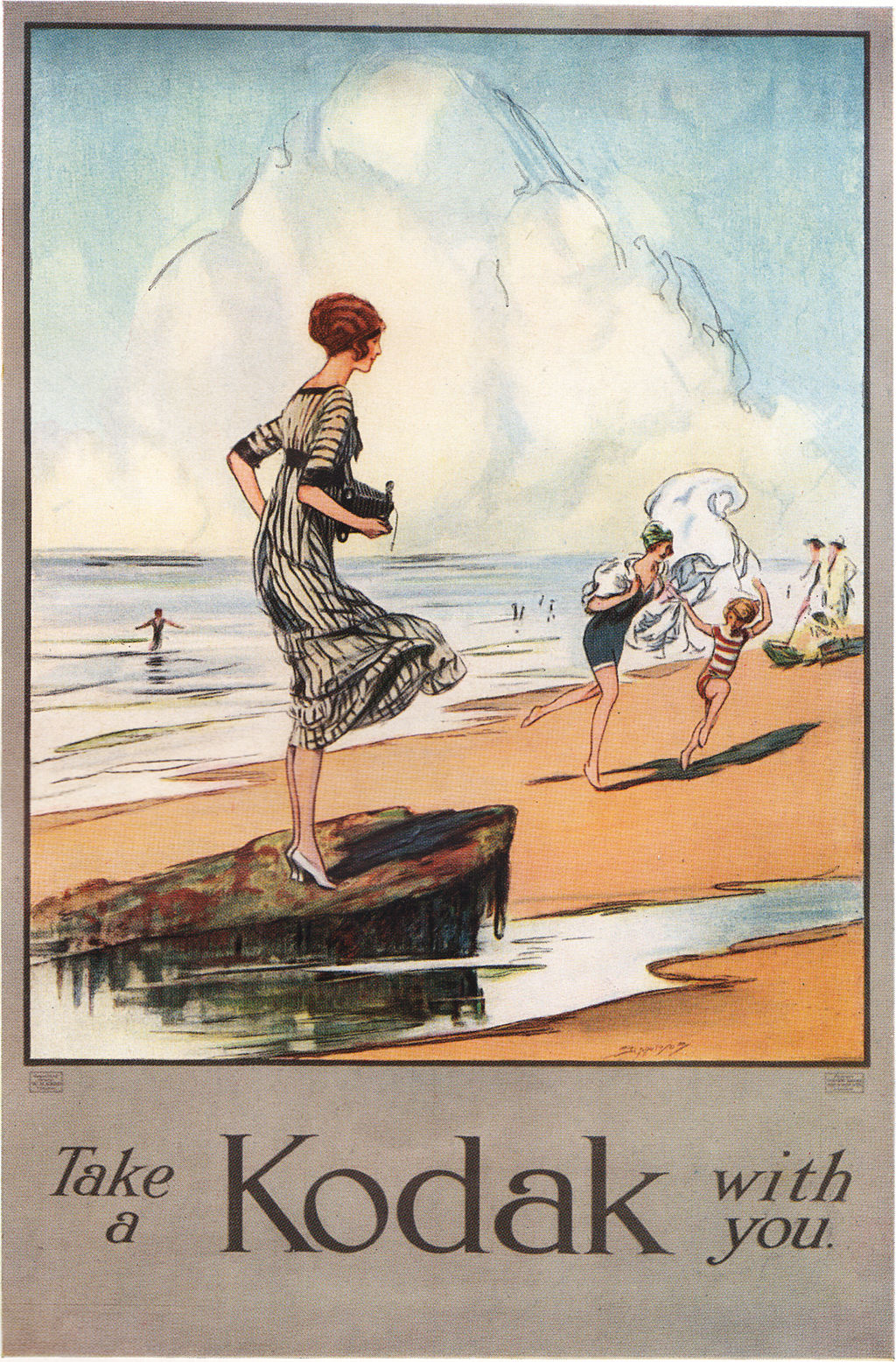
Perhaps it was the case in the 1890s that Kodak directed his advertising at women because they had the hope that women would also embrace the camera and start photographing their everyday lives. It was at a time when women so small began to take a little more care and strive for independence. They thought that women would want to document life, family and the fashion of the time. It started in 1892 when their ads showed the adventurous Kodak girl posing with the camera and taking photographs in various places. It turned out to be a smart move and many women soon had a camera. The women became both photographers and models in the pictures and in advertising.
Claude Allin Shepperson / Public domain
The women in the commercials were not just photographers, over time the promotional images showed how they developed the images and put them together in albums for the family. The family became increasingly central and in the spotlight was the woman who cared for the home and the children and who had the opportunity to document that part of life.
Over time, the images in the Kodak commercial changed from the women as active photographers to be an eye-catcher. It started in the 1930s when the man began to be illustrated as the active with the camera and the woman became the subject, the woman was still part of the adventure. In the 1950s, the images were designed more to show the woman photographing or posing in the nuclear family to move to once again show more adventurous women, but now happy to show as models in a swimsuit and camera as an accessory. The later promotional images perhaps attracted more men than women to buy cameras, perhaps. After the digital camera's entry, the camera industry has generally received some criticism for missing half of the potential clientele in its advertising.
Released by Eastman Kodak, image has "Jessie Willcox Smith" signature. Image also has some text below the bottom right of the image: " Drawn by Collier's Weekly for Eastman Kodak, courtesy Collier's Weekly. Copyright 1904 by Collier's Weekly". / Public domain